
There are places in the world where history feels distant—locked behind glass, reduced to dates and dusty paragraphs. And then there is Pergamon—where history doesn’t sit still. It rises, layer upon layer, asking you not just to observe it… but to walk inside it.
The Pergamon Acropolis: Power, Knowledge, and a City Above the Clouds
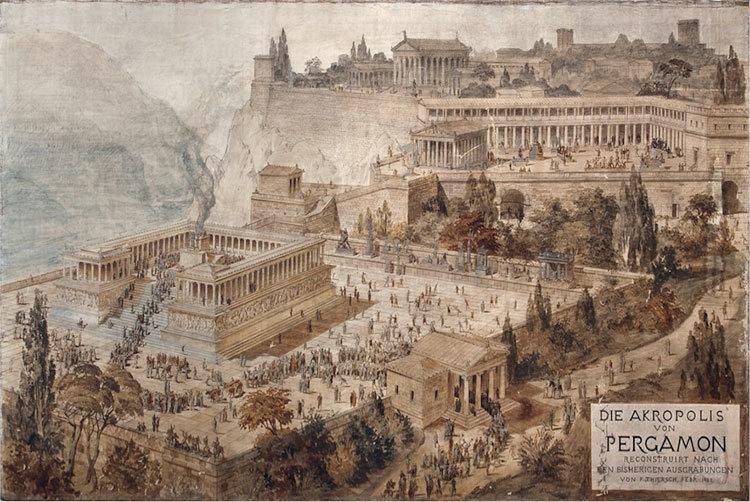
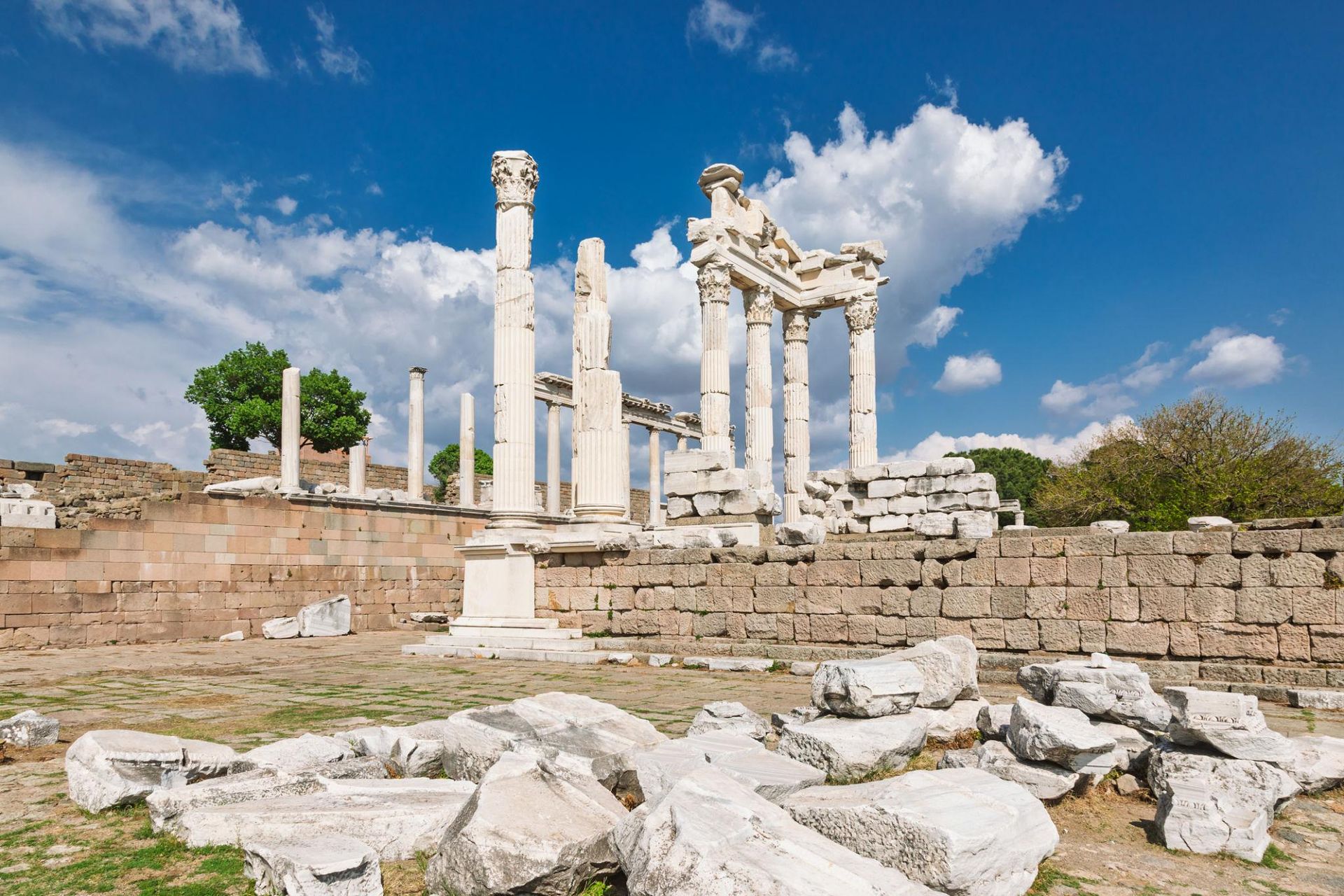
The Acropolis of Pergamon is not simply a high point—it was a statement of power. Built during the Hellenistic period under the Attalid dynasty, this hilltop city was carefully designed to impress, intimidate, and inspire.
Here stood the legendary Library of Pergamon, once home to over 200,000 scrolls, rivaling Alexandria. In fact, when Egypt restricted papyrus exports, Pergamon is said to have perfected parchment—giving the world a new medium for knowledge.
The theater, carved dramatically into the hillside, is one of the steepest in the ancient world. Sitting there, you don’t just imagine performances—you feel the tension between gravity and genius. And just above, the Great Altar of Zeus (now partially in Berlin) once depicted a cosmic battle between gods and giants—a symbolic reminder that Pergamon saw itself at the center of civilization itself.
The Red Basilica: Rome, Egypt, and Byzantium in One Body
The Red Basilica is where empires overlap in stone. Built in the 2nd century AD under Roman rule, it was dedicated to Egyptian deities such as Serapis—already a fusion of cultures.
Massive brick walls, underground tunnels, and towering columns hint at rituals that once blurred the line between religion and spectacle. Later, under Byzantine rule, the structure was transformed into a church, and parts of it still carry that spiritual echo.
Few monuments in the world demonstrate so clearly how belief systems don’t erase each other—they accumulate. Standing here, you are witnessing not one civilization, but a conversation between many.
The Asclepion: Ancient Medicine Beyond Its Time
Long before modern hospitals, Pergamon’s Asclepion was redefining what healing meant. Dedicated to Asclepius, the god of medicine, this sanctuary was as much psychological as it was physical.
Patients arrived via a sacred road, entering a carefully designed environment of water, sound, and ritual. Treatments included herbal remedies, mud baths, theater therapy, and—perhaps most fascinating—dream incubation, where patients slept in sacred spaces hoping for healing visions.
The physician Galen, one of antiquity’s most influential medical figures, trained here. His ideas would shape medicine for over a thousand years.
This wasn’t just treatment—it was an early understanding that healing involves the body, the mind, and the environment together.
Living Streets & Bergama Carpets: A Continuation of Time
Step down from the ancient world, and you don’t leave history—you simply enter its next chapter. Bergama’s restored streets are not reconstructions; they are continuations. Ottoman-era houses line narrow alleys, many now revived as boutique spaces, workshops, and small cafés.
And within them lives one of the region’s most enduring traditions: Bergama carpets. Known for their bold geometric patterns and symbolic motifs, these carpets are not just craft—they are coded stories. Each design carries meaning: protection, fertility, identity.
To watch a weaver at work is to see centuries compressed into a single act of creation.
Where Civilizations Overlap—and You Feel It
What makes Pergamon extraordinary is not just its monuments—but its continuity. Hellenistic, Roman, Byzantine, and Ottoman layers are not separated by barriers or museums. They exist side by side, often within meters of each other.
You can stand in a Roman structure, look up at a Hellenistic acropolis, and then turn into an Ottoman street—all within minutes. This is rare. This is immersive. This is as close as you get to experiencing history rather than learning it.
And then, just when your mind is full—your senses take over. Bergama offers a deeply satisfying gastronomic experience: olive oil dishes rooted in Aegean tradition, slow-cooked meats, local cheeses, and flavors shaped by centuries of cultural exchange.
Pergamon is not a place you check off a list.
It is a place that rearranges your sense of time.
So don’t just visit. Arrive curious. Walk slowly. Touch the stones. Taste the culture.
Come to Pergamon—and experience history not as something that happened, but as something that is still happening.